"HR said I was illegal because I didn't have a biometric card..."

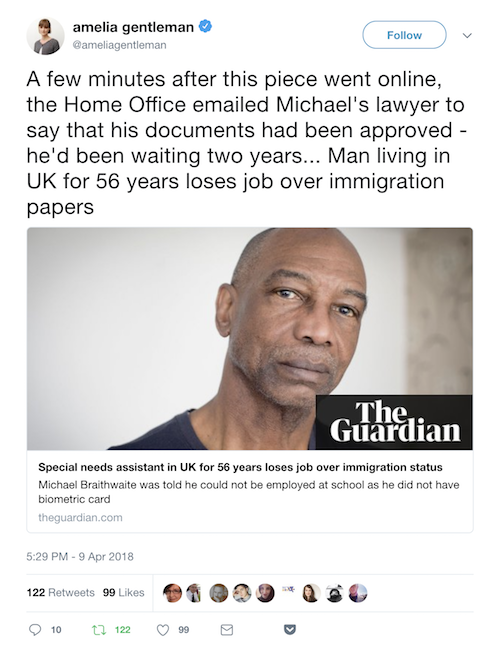
I was following the story of Michael Braithwaite today - the man living in the UK for 56 years who lost his school job over immigration papers.

He is one of an emerging group of people who were born in Commonwealth countries and arrived in the UK as children who have discovered half a century later that they have serious and hard to fix immigration problems.

Amelia Gentleman has been doing a fine job shining a light on these stories at the Guardian

I can't help but think this is putting a strain on those who work in HR at schools and local authorities. It reminds me a little of the testing our integrity discussion we've had here in the past.

The relevant bits from the Guardian piece:

"The personnel department got in touch to tell him that without a biometric card he could not continue to be employed. The 66-year-old lost his full-time job in 2017 after the local authority ruled he needed to submit documentary proof that he had the right to live in the UK. He has been trying for two years without success to get the Home Office to acknowledge that he is in Britain legally.

"Braithwaite was distraught at losing his job. “I had a good rapport with the children. The head said I was an asset to the school, but the HR department said I was illegal because I didn’t have a biometric card."

I hope he manages to to put his life back together again.
Parents
  • The Home Office issues a list of documents which new starters must produce to demonstrate their right to work in the UK. Here it is:
    assets.publishing.service.gov.uk/.../employers_right_to_work_checklist_november_2014.pdf


    The quote (HR said I was illegal ... ... ) makes it seem as if the HR Department is making unilateral and arbitrary decisions but there is no grey area on this. You have the documents or you don't. If you don't, the employer is breaking the law to employ you and is open to prosecution.

    This isn't about HR being a tool of management, it is about all of us being subject to the law. My question would be how he was employed in the first place if he couldn't demonstrate his right to work here.
  • This isn't about HR being a tool of management, it is about all of us being subject to the law.

    That is true, Elizabeth... even if the law is an ass. From the little we know it would seem the school were very sympathetic... but HR less so. The 'system' failed this man.

  • I'm speculating... but in this particular case...

    15 years ago... an interview... application form > born in Barbados but resident in UK since 1961... is it possible that no further questions were asked? I'd be affronted if asked in that context.

    "Braithwaite arrived in London with his family when he was nine, when his father moved to work for the Post Office, and he has lived in the UK since. He had always assumed he was British, having attended primary school and secondary school here, and having worked continuously since leaving school. He married in London and has three British children and five grandchildren."

    I get where you're all coming from... but really???

  • I think what gets me is that this guy wasn't given any benefit of the doubt... it's dismissal. I hope he sues.
  • But Steve

    HR could not give him the benefit of doubt, in immigration, I am sure he was given some opportunity to get evidence of his right to work. The only thing that can be done is a checking service via the borders agency, and that is only if he had an application ongoing or a reference number, this will give 6 months at a time if eligible.

    I cant believe he was just sat down and told to go as this issue was raised in 2016 but he was not dismissed until 2017 - so some conversations must have taken place.

    But even so 15 years ago right to work checks should have been done, so an oversight did take place, and he should have been asked for passport and birth cert at that time - to check eligibility all employers had to do this.

    So yes someone has made a mistake 15 years ago, but when that mistake becomes know, HR cannot break or change the law

    Sharon
  • There are 5 potentially legal reasons for terminating employment. One of them is where continuing to employ the person would break a law. Sadly, if Mr Braithwaite was dismissed because it was illegal to employ him, then he isn't going to have a case against the school. The school did the only thing they could legally do.

    Having said that, they could have re-employed him as soon as he had his paperwork. We don't know all the facts but I would think that was a choice that was open to the school to make but for some reason they didn't.
  • PS All of the above is from my head. The rest of me would like to break into Lunar House and scream at them that they are destroying people’s lives. But my head knows Home Office staff are only following government policy so I suppose that just leaves us with writing to our MPs.
  • This is shameful.

    Steve, I am sorry that I keep hammering away at this point but why is HR being portrayed as the bad guy? This is shooting the messenger and we should insist on the blame being put where it belongs.

  • I completely agree. As Authorising Officer for my organisation, which employs around 120 people with a "restricted" right to work, I have had to dismiss more than once when we have no evidence ofor that right. I do not take this lightly but do everything possible to find some way of obtaining the evidence, including asking the Business help desk for advice (nearly always a waste of time as they simply quote the regulations which I am already aware of) or carrying out an ECS check. Unfortunately if the response comes back indicating no evidence or no right to work, ignoring that simply puts our licence in jeopardy and therefore the ongoing right to live and work of our sponsored workers. We cannot suspend,as that is still employment. We can reengage (but not reinstate) when the right to work is verified.

    The biggest problem and most unfortunate scenario is where an individual like this case has lived here a long time, has no means of demonstrating right to work but was not subject to the check in previous years so was legally employed up to the point that he was legally required to demonstrate right to work and couldn't.

    It's distasteful and makes me ashamed of my country.
  • The biggest problem and most unfortunate scenario is where an individual like this case has lived here a long time, has no means of demonstrating right to work but was not subject to the check in previous years so was legally employed up to the point that he was legally required to demonstrate right to work and couldn't.

    Thank you, Helen. I do think that this is the scenario that is so disturbing me. I am hopeful that the Govt will see that this is 'catching out' people never intended to be the 'targets' (excuse the messy choice of words)... but I won't hold my breath.

    I would hope that Home Office staff are questioning certain decisions with their superiors, too... but they most likely have quotas and targets to fulfil. Grrr...

    ps Your post was your 100th! Thank you, Helen :)

  • Couldn't agree more Elizabeth about the Home Office. They just follow a list of prescribed policies with absolutely no common sense or logic.

    We (the UK) allow convicted criminals who are not British citizens here to stay here after having spent time in prison because; "It is against the Human Right's Act to send them back", as they are entitled to 'have a family life', etc., etc.,
Reply
  • Couldn't agree more Elizabeth about the Home Office. They just follow a list of prescribed policies with absolutely no common sense or logic.

    We (the UK) allow convicted criminals who are not British citizens here to stay here after having spent time in prison because; "It is against the Human Right's Act to send them back", as they are entitled to 'have a family life', etc., etc.,
Children
  • I watched an item about this on Newsnight yesterday evening. They showed a clip of Amber Rudd informing parliament that the Home Office had put policy ahead of people and apologising to the Windrush generation. However, the civil servants of the Home Office was following the instructions of their political masters.

    It was the stated aim of this government under David Cameron, whose Home Secretary was Theresa May, to slash immigration. Here is an excerpt from the speech he made in 2011 where he set out government policy on immigration:

    "What I have set out today is a sober, comprehensive and effective plan to cut immigration, and cut it substantially.

    Sober because we come to this debate clear-headed about not only the benefits of immigration…

    …but also its impact on our public services, communities and society.

    Comprehensive because we are leaving no stone unturned, taking action across all routes of entry to our country.

    And effective - because we are doing all this in a way that strengthens our economy and enhances the status of our universities.

    This time last year, we said we would listen to people's concerns and get immigration under control.

    Today I can confidently say that we are getting there.

    If we take the steps set out today, and deal with all the different avenues of migration, legal and illegal, then levels of immigration can return to where they were in the 1980s and 90s, a time when immigration was not a front rank political issue.

    And I believe that will mean net migration to this country will be in the order of tens of thousands each year, not the hundreds of thousands every year that we have seen over the last decade."

    Here is the whole speech:

  • Following on from my post above, policy may have been set by the government, but in my contacts with the Home Office, the people I had dealings with appeared to have embraced the idea that their role was to keep people out, even if an employer was supporting an application from someone who would have been an asset to the business and to the country. There seemed to me to be a culture of "Don't care, won't care" and I am not surprised by Helen's experience.

  • In my experience that's always been the case. Early in my HR career (many years ago now) I was applying for work permits for electrical engineers. It was on record there was a major shortage of people with this skill. The initial response from the HO was to ask why I wasn't employing someone from the UK (even though I'd submitted proof of the shortage).

    It seems to me that part of the problem is that Civil Servants so rarely seem to live in the real world. Which also explains some of the curiosities that creep into employment legislation.
  • It seems to me that part of the problem is that Civil Servants so rarely seem to live in the real world. Which also explains some of the curiosities that creep into employment legislation.

    I think too often people hang their common sense with their coat every morning. They stop being empathetic and the 'rules' and 'culture' kick in. As Helen says, no wriggle room or discretion to apply to "the many different circumstances people find themselves in". Too much hassle to challenge... a mortgage to pay, etc. We do see this from time to time on this Community. 

    I often say to colleagues that this Community is our most human service.