133

Coronavirus: what contingency plans are you putting in place?

Steve Bridger

| 0 Posts

Community Manager

28 Feb, 2020 13:37

We've had a discussion thread already touching on the Coronavirus (COVID-19), but things have moved on a bit and we'd like to ask members to use this space to share initiatives and plans around managing the coronavirus threat in your organisation.

Please refer to the CIPD factsheet for current guidance and also the latest information on the GOV.uk website.

The CIPD has been asked to speak on national news channels* about what businesses can be doing to manage issues affecting employees, such as flexible working, A+B teams coming into work, school closures, business travel etc.

*If you are happy to speak to the media, who are looking for real examples of businesses taking action, please let us know as we do sometimes get asked to recommend companies who could be featured. To reassure you, this is a closed thread and no-one can see it except CIPD staff and CIPD members. 

We’re well placed to help if you have any questions... and we’re interested to hear what actions you’re taking in your own organisations.

Please share below. Thanks.

UPDATE: 10th March 2020
16974 views
  • Hello everyone

    We had a business continuity plan already in place but everything in it was written with the tacit assumption that there would be an event, we'd sort ourselves out after the event and then we'd be back to normal. So we have been scenario planning for every function, assuming that we might need to survive for a number of weeks with parts of the country under lock-down, the public scared to come out to buy non-essentials and suppliers unable to maintain their normal service.

    We set two objectives for our pandemic plan: to keep as close as we can to business as usual; and for our staff to feel safe at work, confident we are following government advice, well-informed and supported.

    For HR, I have looked at our suppliers. We have an outsourced payroll. Fortunately, they are equipped for their whole staff to work from home and they have already tested this in a simulated disaster exercise. That was a relief.

    We have spoken to our OH company about risk assessing people living with health conditions that put them at higher risk. I had been thinking about the obligation on employers to provide a safe place of work and systems of work, and that what might be safe usually may now present a risk to some people. For example, we have not instituted a general travel ban yet but it might be reasonable to bring one in earlier for people at higher risk such as asthmatics or anyone immuno-suppressed. They suggested that we wait for our first case before we do this. I think that might be too late, but now feels to early. I shall ponder over the weekend.

    I have a proposal in front of the board to up-rate some staff benefits temporarily. The biggest worry I hear from staff is not catching the virus but schools closing, so we are looking at increasing our support for working parents and grandparents. We are also looking at topping up our occupational sick pay to prevent anyone coming into work because they can't afford to self-isolate.

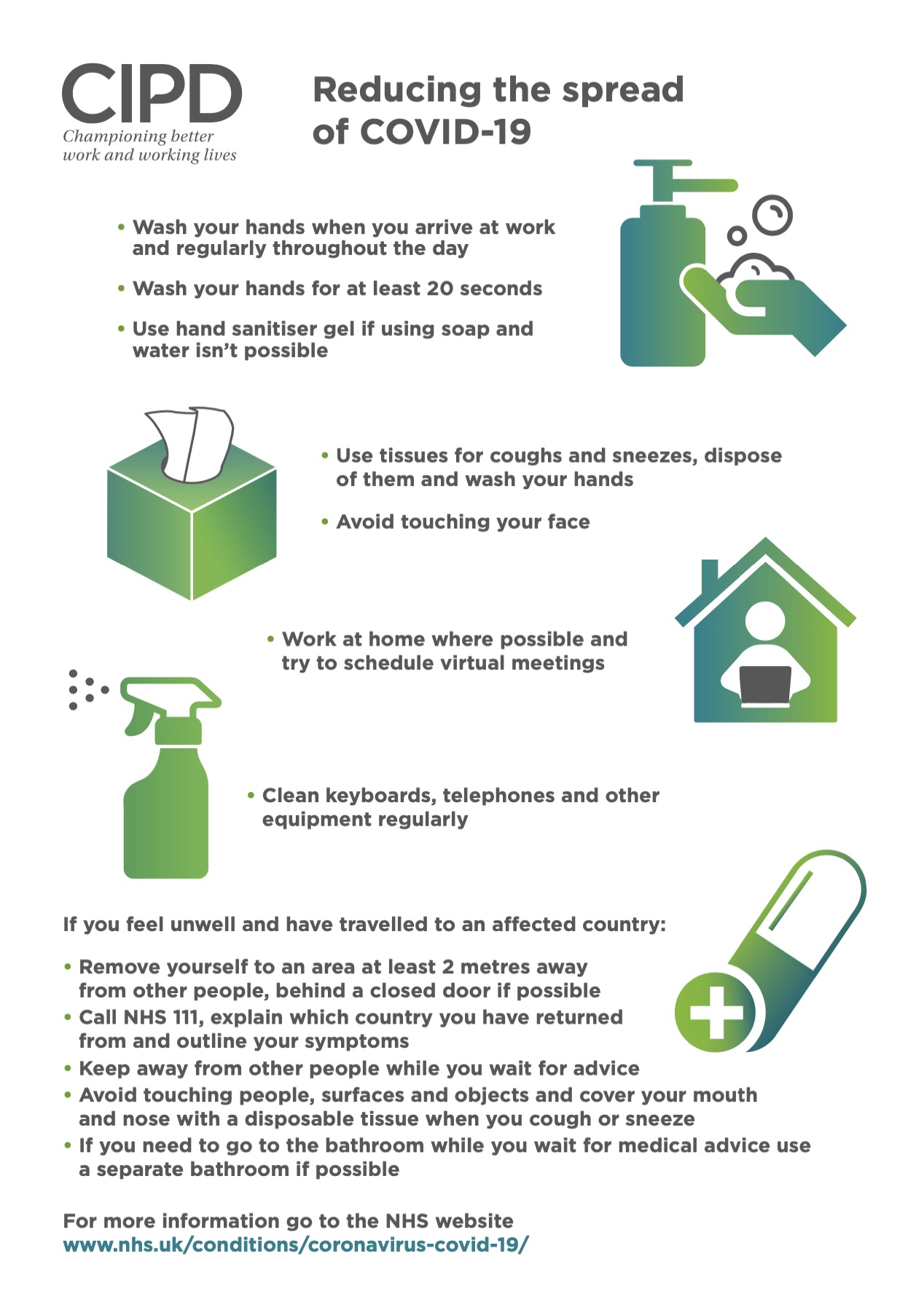
    We are sharing infection control information via posters and briefings; we are issuing tissues and hand sanitiser etc. We already have the technology and systems in place for working from home for those jobs that can be done from home.

    We have checked that we have up-to-date contact and emergency contact details for everyone.

    This morning, I saw an interview with Sir Patrick Vallance, the government's Chief Scientific Advisor, on BBC1. He said that he expects that cases will rise for 12 weeks and then fall for 12 weeks, with 95% of cases of falling in the middle 9 weeks, so that gives us a timescale for planning.

  • In reply to Elizabeth Divver:

    Quick question if you don't mind Elizabeth - what increased support are you putting in place for working parents and grandparents? That's the kind of thing that I know our staff would really value (ironically, as we are a school ourselves), and I'm keen to think of any way we can help.
  • Johanna

    | 0 Posts

    CIPD Staff

    9 Mar, 2020 11:45

    Hi everyone, as we've discussed on this Community thread, the global spread of #coronavirus is causing logistical and operational problems for businesses, as well as putting extra demands on #HR to deal with the physical and emotional toll. People Management magazine and the CIPD want to understand what sort of arrangements organisations have put in place to manage the outbreak, this will help us continue to support you in the best way possible with relevant advice and content. Please help us by taking this short survey now: http://ow.ly/AZpT50yGq3g
  • In reply to Nina Waters:

    I have more questions than answers - it would be great to hear how anyone is treating these key questions:
    - What if schools are closed - who will be impacted and what pay, if any will they receive if they have to take time off to manage childcare - expect this to impact parents and grandparents
    - What if care homes are closed - who will be impacted and what pay, if any will they receive if they have to take time off to care for family members (this may include the elderly and those with severe mental/medical disabilities).
    - The above will come under Time off for Dependants - which for most organisations will be unpaid. Are organisations choosing to enhance this in these exceptional times? If so, how will additional payments be monitored? What evidence will be available from employees to be eligible for this?
  • Has anyone implemented fever screening at work as a response to Covid-19? Thinking about the implications, the data is likely to be covered by GDPR, would there need to be a signed agreement? Any thoughts on such a scheme?
  • Steve Bridger

    | 0 Posts

    Community Manager

    10 Mar, 2020 11:35

    Neil Morrison's latest blog post is well worth your time.

    COVID- 19 provides us with a moral leadership question

    Most of us will not have experienced an event of this kind before, this is unchartered water. We have a choice about how we look at the impact it will have on our workforces and that choice will pretty much define how we are as an organisation. We can see it as our responsibility to protect, to reassure and to look after our workforces, to work together to see this through. Or we can look at our ability to protect ourselves from the impact this will have on our workforce, to minimise their risk to our organisations and to only do what we are legally obliged to do.

    As Neil says: Which side do you want to be on?

  • In reply to Steve Bridger:

    Thank you Steve :)
  • In reply to Nina Waters:

    Hi Nina

    We are an SME with tight budgets. Here is what we're doing:

    We already offer all staff up to 3 days paid leave in a rolling year to care for a sick child or grandchild and up to 3 days or a sick or elderly relation.

    We know that some schools have already closed and others may follow. The Government’s Chief Medical Officer has said that school closures may last for weeks. People will need time to put new arrangements in place. Therefore, we are publicising our paid dependent’s leave and suggesting that some additional days could be covered from people’s holiday entitlement. As we are nearly at the end of our holiday year and people might not have the holiday to use, we will allow them to pull forward holiday from next year, provided they don't dip below 5.6 weeks including bank holidays. This means the newest staff can pull forward up to 5 days and the longest serving up to 10 days.

    After this, we will consider requests for flexible working arrangements at home such as early or late start and finish, fewer longer days, splitting the day and working early and late etc we will consider whatever works so that people are able to continue working.

    If someone's child is actually ill, then they will be self-isolating and this will be treated as sick leave, not leave to care for a sick child. We have said that if people can work while they self-isolate, they should. However, if their job cannot be done from home and they doesn't have enough sick pay left to cover self-isolation, we will top them up to a maximum of 10 days. If anyone actually goes sick and doesn't have enough sick pay to cover it, we will top them up to a maximum of 5 days. This is because all the advice seems to agree that for the majority of people, coronavirus is a mild infection.
  • In reply to Elizabeth Divver:

    Thank you Elizabeth - that's really helpful.
  • In reply to Ruth Pankhurst:

    I'm really interested in this too! It's going to be a challenge to support everyone fairly.
  • In reply to Nina Waters:

    It was hard to try to provide a quick measure for the board on what the additional sick pay could cost. We ended up calculating the cost of everyone taking a 3-week top-up but stressed that most people do have some sick pay, many people can work from home and won't need to be paid for self-isolating and most people won't need the full 3 weeks. I also said that to work out the value of the top-up each person would need would be a fiddly and time consuming calculation at a time when we need to move fast, and we still would have to take a guess at how many people would actually need it. Thankfully, the board accepted that argument and felt able to sign this off on the information provided.
  • I am aware of one organisation that is attempting to reduce or slow up the risks of virus spreading by half by introducing a temporary shift system as follows - 5 days in the office, followed by 5 days working remotely
  • In reply to Elizabeth Divver:

    This thread is proving a goldmine of information!

    We are looking into the practicalities of homeworking for our workforce, but as this isn't something that is usual for us (we're a School) i'm struggling to work out how we should ensure the staff's homes are safe and suitable from a H&S perspective. I understand it's treated as an extension of the workplace but i'm not sure how to go about ensuring a workforce of 170 odd people have a safe place to work! Does anyone have any suggestions of how they plan to do this? It's manageable when it's the odd person self isolating due to being in contact with an infected person (but not themselves ill which would be covered under sick leave) but i'm not sure what we'd do if the School had to close quickly.

    Am i overthinking this?

    Thanks for any help you can provide!
  • We support people with disabilities in their own homes, we have plans in place and are looking at how we can share support, when and if we need staff to self isolate.

    We are looking to see if we can use a building that has been used for respite in the past if people supported need to self isolate.

    Sickness strategies are in place and a clear plan of action, but we are waiting for the updated Social Care action plan.

    Good times

    Sharon
  • In reply to Kayleigh :

    Given that the school does not own, rent or manage the 170 premises from where your employees could be working remotely, I would have thought that your responsibilities could be limited to facilitating some kind of self certification process. You provide a guideline on the essential features of a safe place of work and employees self certify that they have gone through your checklist and can confirm that their place of work complies with the minimum standard required.
    Alternatively, you could ask employees to sign a document saying that they accept that working from home is at their risk as the company is not responsible for controlling the "remote" premises. You raise a good question and I think that my first port of call would be to speak with the broker or underwriter of your Employers Liability Insurance - such a conversation might provide the direction needed to balance the insurance risk with your duty of care.